Improve · Aesthetary Original
Keep content and evidence true over time
You'll be able to date every claim on a live site, set what triggers its review, and mark claims stale when their source changes.
In this skill
Every claim carries the date someone last checked it.
When a source changes
- Find every claim citing it
- Mark each one stale
- Re-check, reword or remove it
- Re-date it, then clear the mark
Date each claim. Mark it stale when its source changes. Never move a date alone.
1 more scene is in the video and the transcript.
Transcript
On launch day every claim on the site can be true. A year later the opening hours have changed, a teacher has left, and the page still says 'new this spring'.
Claims go out of date at different speeds, and you can predict which ones. Prices change. People leave. Opening hours move with the seasons. Awards and memberships have years attached, and some lapse. And any word that points at time, like new, recent, latest or this year, starts going wrong on the day you publish it. Those are the claims to watch.
The claims list you built before launch already holds each claim, its status and its source. Add one more column: the date someone last checked the claim against that source. Without it, a claim checked last week and a claim checked two years ago look exactly the same, and that's how a stale one stays up.
Here are three rows from a fictional studio's claims list. Each now has a checked date and a review rule. For the price, the trigger is the studio's price list changing. For the teacher, it's any change of staff. 'New' gets an expiry date, because new can't stay true forever, and on that date the word comes off or the sentence gets rewritten.
Triggers matter because sources change without telling you. When the price list changes, search the claims list for every claim that cites it, and mark each one stale. Then re-check it, reword it to what the new source supports, or take it down. Only then does it get a new date. A stale mark in the file is fine for a day. On the live page, the claim is simply wrong.
Search thoroughly, because one source turns up in more places than you'd guess. At the bakery, one price is on Today's bread, on the order page, and in the file that builds both. Your coding agent can run that search across every file in seconds. Ask it to list each claim that cites the source, then check its list against the live pages yourself.
Good records work the same way. Each claim says what kind of claim it is, what it rests on and when it was last checked. Where nobody has checked, the record says so instead of filling the gap.
You'll be offered a shortcut, sometimes by an agent: change the date on a page so it looks fresh. Google lists that as a warning sign, changing the date of pages to make them seem fresh when the content hasn't substantially changed. It also says adding or removing lots of content to seem fresh won't help. So the date follows the work. If a page shows 'Last updated', Google's byline guidance says to label it clearly and keep the visible date and the structured-data date the same.
So the claims list now runs on two kinds of timing. Triggers fire when something changes, and the owner usually knows first, so ask them to tell you: a new price, a new person, new hours. Expiry dates fire on their own. Put a monthly look at the expiry column into the check routine from the last lesson, and nothing time-bound outlives its date.
Date every claim when you check it. When a source changes, mark what depends on it stale, and never move a date without changing the words.
Next 5
Everything in Improve Build a source inventory you can trustTurn a harvest into an inventory where every item has a source and a date.3 min video
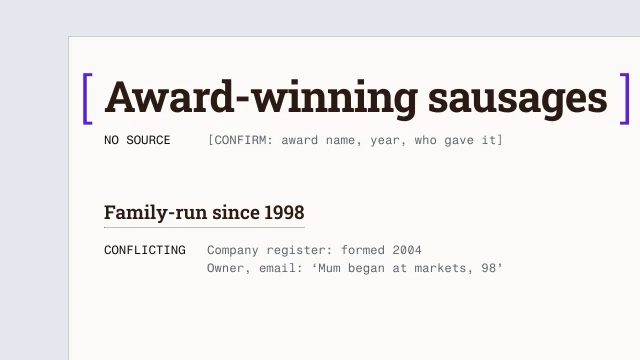 Map every claim to its sourceGive every claim on a site a truth status and a source before it's published.3 min video
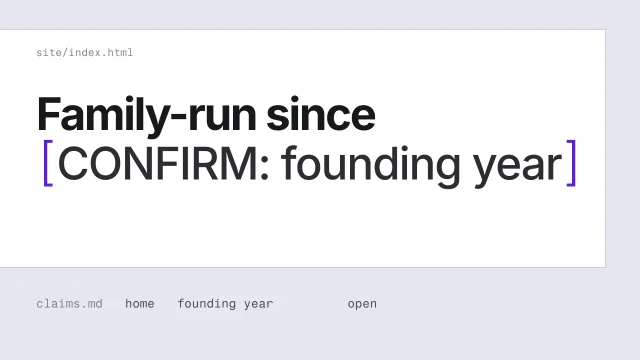 Never invent a factHandle a fact you can't confirm without putting a believable guess on the page.3 min video
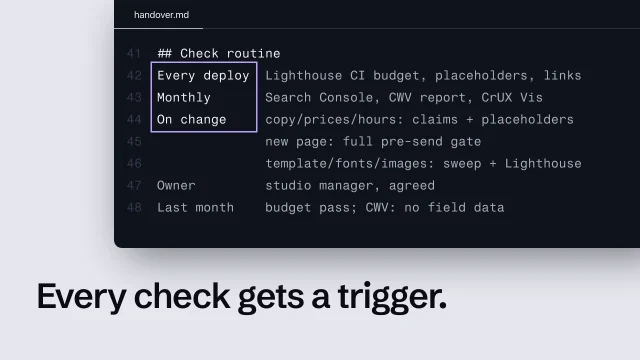 Set a post-launch check routinePut every launch check on a trigger, and know what to do when there's no field data.4 min video
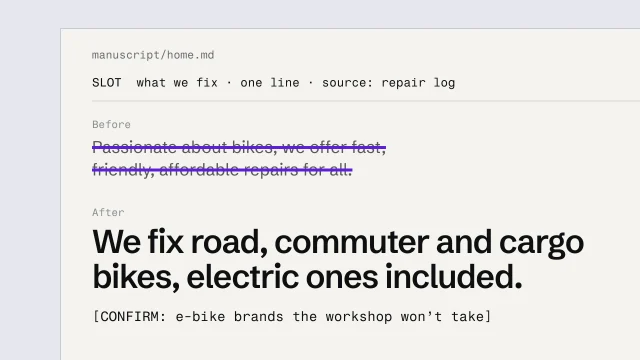 Write specific, true copy for each slotWrite copy only this business could say, and cut what sounds machine-written.4 min video