Prepare · Aesthetary Original
Never invent a fact
You'll be able to handle a fact you can't confirm without putting a believable guess on the page.
In this skill
No placeholder survives to a page anyone can open.
- 'Family-run since 1998'
- 'Over 2,000 happy customers'
- A five-star quote, no name
- [CONFIRM: founding year]
- [CONFIRM: customer count]
- No reviews section yet
Every placeholder's route
- Write [CONFIRM: what you need]
- Add it to the client checklist
- Client answers; note the source
- Replace it with the real fact
If you can't trace it, it doesn't go on the page.
3 more scenes are in the video and the transcript.
Transcript
The most dangerous sentence on a draft site is the one that sounds right. Over two thousand happy customers. Where did that come from?
Start by knowing what counts as a fact on a website. Numbers. Reviews and testimonials. Prices. Credentials, awards and certifications. Founding dates, names, addresses, opening hours. If a reader would trust the business or act because of it, it's a fact, and it has to come from somewhere you can point to: the client, or something the client sent you. The AI writes these easily, because sites like this usually have them. That's why they turn up in drafts nobody asked for.
When you don't have the fact, you have two options and only one of them is honest. A guess reads well, and nobody notices it's wrong until a customer does. A placeholder is ugly on purpose. Square brackets, the word confirm, and what you need. It looks unfinished because it is. Reviews are different. No placeholder makes a made-up quote acceptable, so leave the section out until real ones arrive.
Every placeholder takes the same route. You write it into the page. You add it to the client checklist, with the page it sits on. The client answers, and you note where the answer came from. Then you swap the placeholder for the real fact. The checklist is also the list of what's blocking launch, and you can send it to the client as it stands. Always use the same brackets and the same word, so one search finds every one of them.
Here's the checklist for a fictional bakery. Open items, closed items, and where each answer came from. Look at the head baker's training. Two sources gave different accounts. When sources disagree, don't pick the one that sounds better. Picking one is still a guess, just a guess with a link next to it. Leave it out and ask. When the evidence runs out, say less.
Your coding agent can help you find them, as long as it isn't the one deciding. Give it a prompt like this. List every fact on the homepage, and for each one give the line in claims dot md it came from, or write none. Then you go through every claim marked none. Each one gets a source from the client, becomes a placeholder, or comes out. Don't let it fix them on the same pass. You want the list first, so you can see what it was about to invent.
A placeholder only works if it never reaches a page people can visit. I've seen a live client site go out with unfilled brackets where the legal entity name should have been. In one way that's worse than a guess, because everyone can see it. So the last check before any send or launch is a search of the whole build. Zero results, or it doesn't go.
Here's that search, on the fictional bakery build. The first one looks for the confirm format and finds nothing. Good. The second looks for any lowercase words inside square brackets, because a placeholder someone typed their own way slips past the first search. It can also catch code that happens to use brackets, so read each hit. This one is real: the legal name on the About page. That page doesn't ship until it's filled.
If you can't trace it, it doesn't go on the page.
Next 3
Everything in Prepare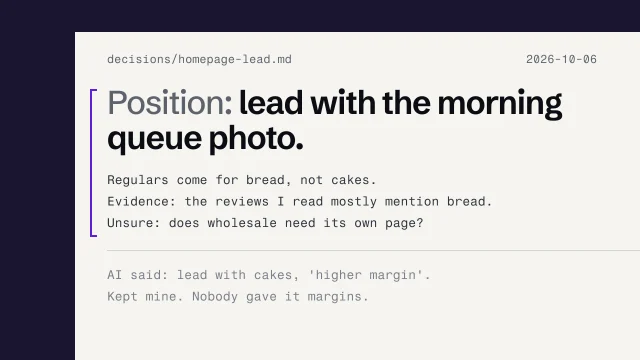 Decide first, then ask the AIPut your own answer in a file before any AI sees the question, then compare the two.3 min video
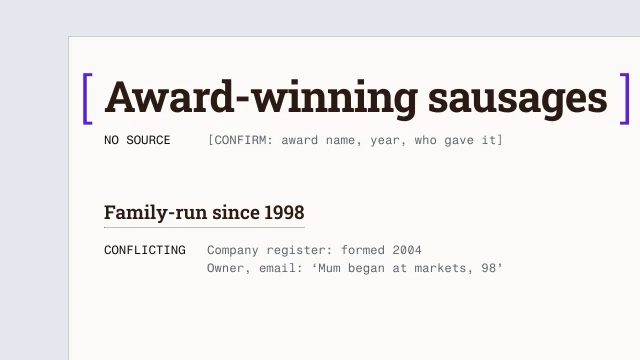 Map every claim to its sourceGive every claim on a site a truth status and a source before it's published.3 min video
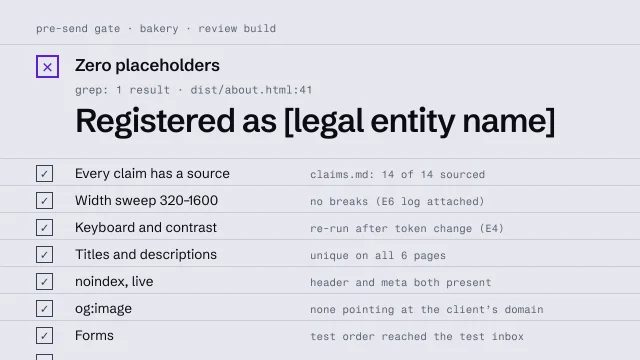 Run a pre-send gateCheck a build against a fixed list before anyone outside sees it.4 min video