Structure · Aesthetary Original
Write specific, true copy for each slot
You'll be able to write copy that fits its slot, says what only this business can say, and holds up when someone checks it.
In this skill
Write slot by slot. Each slot already tells you the job.
- Artisan sourdough boule
- Viennoiserie
- Pre-order service
- The sourdough
- Morning buns
- Order ahead
- Fresh, delicious, artisan
- Passionate about baking
- Expert bakers
- Quality you can trust
- Baked every morning
- Order by 6 pm for next day
- Since [CONFIRM: year]
- Six loaves, a daily limit each
If a competitor could paste your sentence onto their site, it isn't finished.
2 more scenes are in the video and the transcript.
Transcript
Here's a line from an AI's first draft of the bakery's About page: 'Nestled in the heart of the neighborhood, we're passionate about baking fresh, delicious, artisan bread for everyone.' Every bakery in the country could put that on their site tomorrow, and that's what's wrong with it.
Write slot by slot. The content model already tells you each slot's job, how long it can be, and where its facts come from. Today's bread's intro is one line, from the head baker's bread list. The order rule comes from the decision made in strategy. When you write to the slot, the padding goes, because there's no room for it and nothing to pad with. Most bloated pages come from someone writing 'the homepage' in one sitting and filling the space.
Then use the words customers use. The bakery's reviews say 'the sourdough sells out by ten' and 'I order the rye for Saturday'. Nobody writes 'artisan sourdough boule'. The glossary you built in research decides the nouns. If a customer would type it into a search or say it at the counter, it belongs in the slot. If only the business says it, swap it for the customer's word or leave it out.
Swap adjectives for specifics. 'Fresh' is a claim nobody can check. 'Order by six for pickup the next day' is something a customer can hold the bakery to. Notice the placeholder. The AI's draft said the bakery opened in 1998, and nobody could find a source. So the line says CONFIRM, in brackets, until the owner tells me. Then run the swap test on every sentence: could a competitor paste it onto their own site unchanged? If so, write what only this business can say, or cut it.
Specific copy makes claims, and claims need sources. For each sentence with a fact in it, find the claim and match it to the claims list you built in research. Baked every morning: the owner says so, and it's on the list. Since 1998: no source anywhere. No source means a placeholder or a cut. And placeholders have to be loud. A quiet one, like 'TBC' in gray text, gets read past and published. Use one format everywhere: square brackets with the word CONFIRM. Then, before anything is reachable, run one text search across every page and file in the project for an opening bracket followed by CONFIRM. You're done when that one search lists every fact still open.
If an AI drafts the copy, give it the slot, the source material and the customers' own words, then read what comes back for the tells. 'It's not just bread, it's a tradition.' Three adjectives where one fact should be. 'Whether you're grabbing breakfast or planning a dinner party.' Words that only exist on websites: nestled, passionate, pride ourselves. And a closing line that says the heading again. None of these is banned. They're the sound of a sentence written for any business, and each one usually sits where a specific fact should go. Find the fact, or delete the line.
Here's the line from the start, rewritten for its slot. It's one line, because the slot says one line. Everything in it comes from the owner, and the year the draft made up isn't in it: that has its own slot, marked CONFIRM, until the owner answers. It's less exciting than the original. It's also the only version a regular reads and thinks: that's my bakery.
If a competitor could paste your sentence onto their site, it isn't finished. Write to the slot, trace the fact, and mark what you can't confirm.
Next 4
Everything in Structure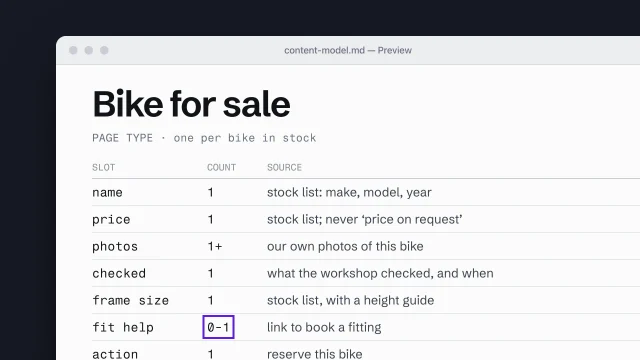 Build a content model from page types and slotsDescribe each page type as the content slots it must hold.4 min video
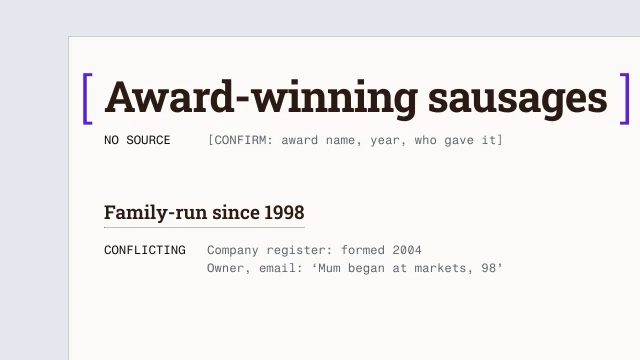 Map every claim to its sourceGive every claim on a site a truth status and a source before it's published.3 min video
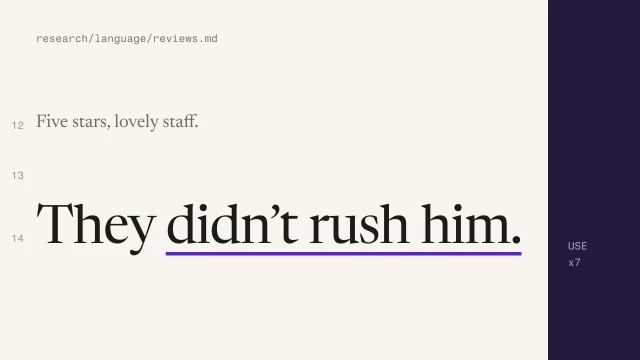 Mine customer language from reviewsFind the words customers actually use, and keep them.3 min video
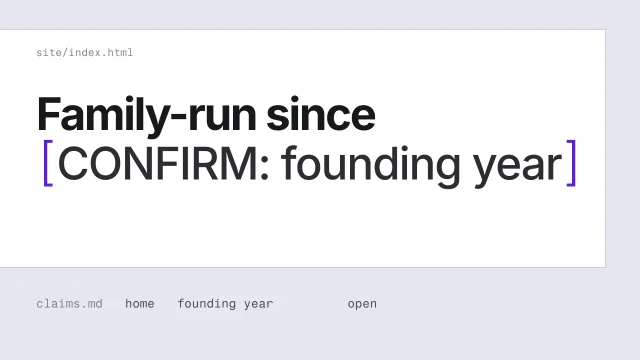 Never invent a factHandle a fact you can't confirm without putting a believable guess on the page.3 min video