Research · Aesthetary Original
Build a source inventory you can trust
You'll be able to turn a harvest folder into an inventory where every item says where it came from and how old it really is.
In this skill
A file's date and its content's date are different facts.
- Forty files called final
- Screenshots with no URL
- A price list, undated
- One row per item
- Exactly where it came from
- Its date, and how you know
Every item gets a source and a real date, or it doesn't go on the site.
1 more scene is in the video and the transcript.
Transcript
A harvest is only useful once you can trust what's in it.
After a harvest you have a pile. Downloads, screenshots, PDFs, pasted text, and the client's own folder of things. A pile feels like research, but you can't build on it, because you can't tell which version of the opening hours is current or where a photo came from. An inventory is the same material with one row per item, saying what it is, where it came from and how old it is. My test for a source field: could a stranger open it and find the same thing? If not, it isn't recorded yet.
Each row has five fields. What it is, in plain words, and who made it: the client, a customer, a directory, you. Where it came from, as a full web address or file path, so anyone can open it. The content date, and how you know that date. Reliability: high, medium or low. And what would raise it. This is the part that saves you when the client asks where a claim on their own homepage came from.
The field that catches people is the content date. When you download a PDF price list, your computer stamps it with today. The server may say it was uploaded last March. Neither is when the prices were set. Open the file. The fictional Harbour Lane clinic's price list says 'from January 2023' in the footer, and that's the date that counts. If nothing in the content gives a date, write 'undated' and lower the reliability. Don't fill the box with the file's date because it looks empty.
Here's that row. The source is precise enough to reopen. The date comes from the content, with a note so nobody, person or agent, swaps it for the download date later. Reliability is low, and the reason is written down: another source shows different prices. And the last field is already a question for the client.
Low reliability is a note about how far you can lean on a source. A source drops when it has no date or an old one, when you can't say who made it, when it disagrees with something more direct, or when it's a copy of an original you haven't seen. A directory that copied the clinic's hours years ago is all four. It still goes in the inventory. You just don't put its hours on the new site.
Then say what would raise it. Find the original the copy came from. Find a second source that didn't copy the first. Ask the client to confirm in writing, so the confirmation becomes a dated source of its own. If none of that is possible, the item stays in the inventory marked low, and stays off the page. Filling in this field gives you a short list of questions for the client, which is exactly what the harvest was for.
Your coding agent is useful for the first pass. It can walk the harvest folder and draft a row per file. It's weakest on the two fields that matter: it can easily take a file's date for a content date, or call a confident-sounding page reliable. So tell it to leave the date blank when the content gives none, rather than guessing. Then check every date and every grade yourself. Keep the inventory as a file next to the harvest, so the next session starts from it.
Every item gets a source and a real date, or it doesn't go on the site.
Next 4
Everything in Research Harvest a client's whole web presence with AICollect everything a business already has online before asking them for anything.4 min video
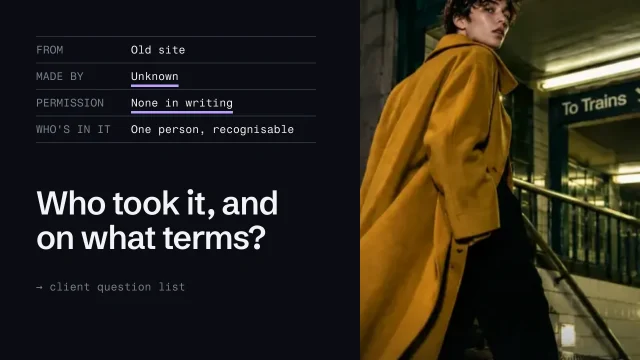 Check image rights and use AI imagery honestlyKnow which images you may use, and use generated images without misleading anyone.4 min video
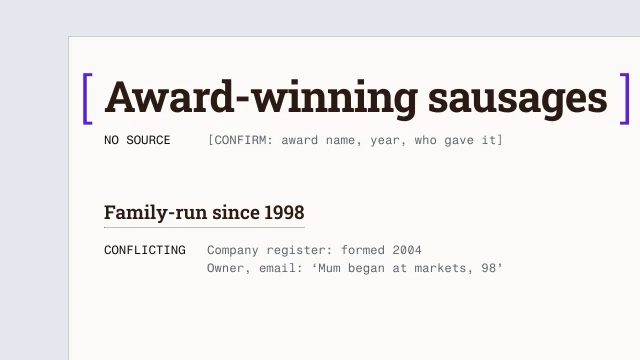 Map every claim to its sourceGive every claim on a site a truth status and a source before it's published.3 min video
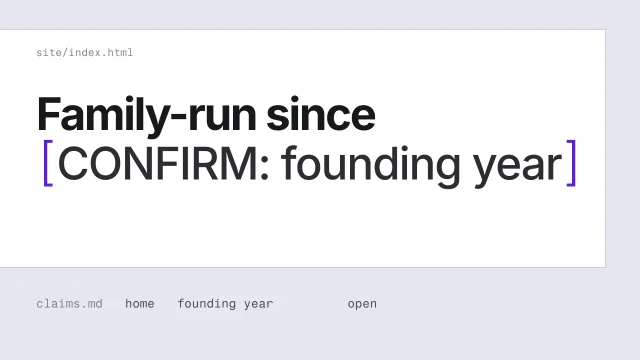 Never invent a factHandle a fact you can't confirm without putting a believable guess on the page.3 min video