Research · Aesthetary Original
Map every claim to its source
You'll be able to give every factual claim on a site a truth status and a source before it's published.
In this skill
A claim is any sentence that could be checked and found false.
Map one claim
- Copy it word for word
- Find its source and date
- Give it a status
- Keep, reword, placeholder or cut
No source, no claim. A visible placeholder until there is one.
1 more scene is in the video and the transcript.
Transcript
Every site makes claims, and nobody reads them as claims until something goes wrong. Before this one goes live, you'll know which of them are true.
'Family-run since 1998.' 'Every loaf is baked every morning.' 'We deliver across the neighborhood.' Each of those is a fact someone could check and find false. On a client's site, you're the one publishing it. So before copy is final, every claim gets mapped: what it says, whether it's true, and how you know.
Go through the draft copy, the old site and anything the client wrote, and pull out every claim. They cluster. Any number, any year. Awards, accreditations and memberships. Superlatives, especially 'only' and 'first', which are claims about every competitor too. Quotes and testimonials. Prices and guarantees. Your coding agent can do a decent first sweep if you ask it to list every checkable statement word for word. Then read it yourself, because the quiet ones slip through.
For each claim, the routine is the same. Copy it exactly as written, because rewording it is how a false claim gets softened into one nobody checks. Find its row in your source inventory, which already has a source and a date, or note that there isn't one. Give it a status. Then decide what happens to it: keep it, reword it to what the source supports, replace it with a placeholder, or cut it.
Four statuses do the job. Verified means you have a source you could hand to someone else. Client says means the client confirmed it in writing and you couldn't check it independently, which is often fine for things only they know. Conflicting means sources disagree, and the rule is to leave it out until it's resolved. Don't pick the version you like. No source means a placeholder, or cut it. Put the status next to the claim in the copy file itself, so whoever edits the copy next can see it.
Two rows for a fictional butcher's. 'Family-run since 1998' is conflicting. The company register says the business was formed in 2004. The owner says her mother started selling at markets in 1998. Both can be true, so the fix is wording both sources support, agreed with the owner. 'Award-winning sausages' has no source, so it becomes a visible placeholder asking for the award, the year and who gave it. From there it follows the placeholder route from the lesson on never inventing a fact: onto the client checklist, and searched for before anything is sent.
Rewording is the move people forget. 'The best butcher in town' can't be proven by anyone. 'Trading in the town since 2004' can, and it's more interesting. A customer count with no records behind it goes, and something you can check takes its place. Narrower wording almost always reads as more confident, because it's specific.
No source, no claim. A visible placeholder until there is one.
Next 4
Everything in Research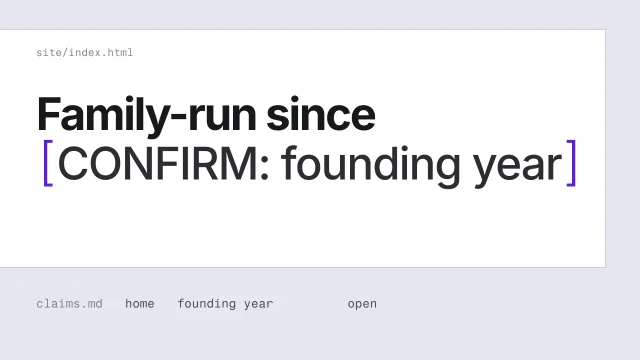 Never invent a factHandle a fact you can't confirm without putting a believable guess on the page.3 min video
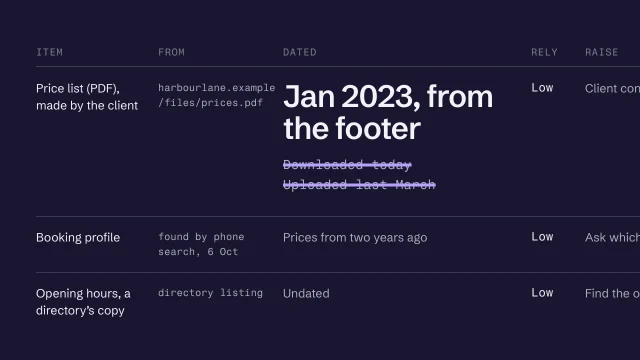 Build a source inventory you can trustTurn a harvest into an inventory where every item has a source and a date.3 min video
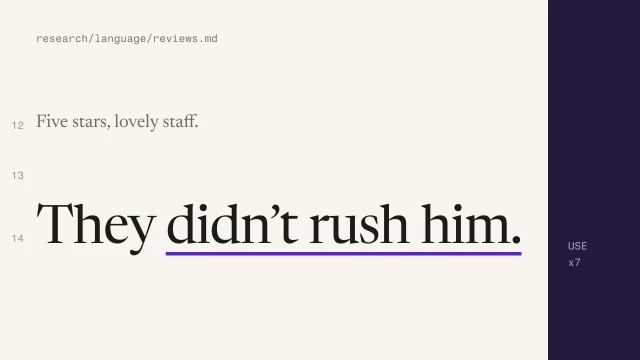 Mine customer language from reviewsFind the words customers actually use, and keep them.3 min video
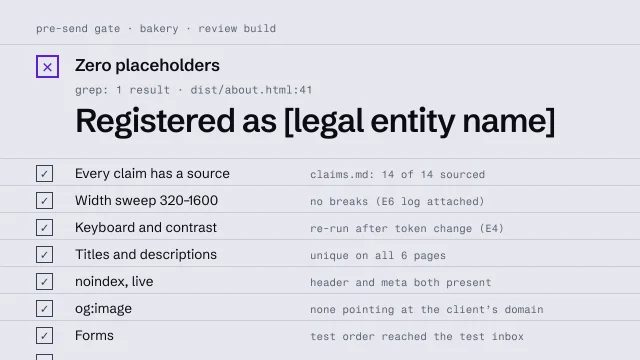 Run a pre-send gateCheck a build against a fixed list before anyone outside sees it.4 min video