Design · Aesthetary Original
Write an art-direction brief that survives the build
Write a direction down so precisely that the AI agent building the pages can't drift from it, and a reviewer can check it didn't.
In this skill
One decisive move. The others follow from it.
- 'Timeless craftsmanship'
- 'Premium but approachable'
- 'See how every book is made'
- Every section traces to it
If the build could drift without breaking a line of your brief, the brief isn't finished.
5 more scenes are in the video and the transcript.
Transcript
Most art direction dies quietly in the build. The direction was agreed, the agent started on page one, and by page five it's a pleasant generic website in the right colors. The fix is a brief so precise that drift breaks a sentence.
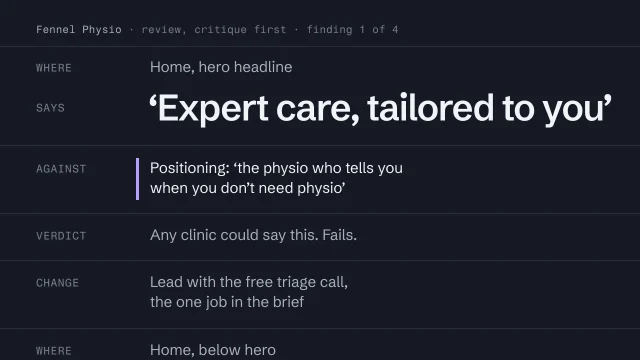
There are six parts, and each one has to be checkable, by you, by a reviewer, or by the agent itself halfway through page four. A line nobody can check against the build is a mood, and moods don't survive.
The concept is one idea the whole site expresses, in a sentence a stranger could test. Take a fictional bookbinder. 'Timeless craftsmanship' fails, because any page passes it. 'See how every book is made' works. Any section that can't trace back to that sentence gets cut, and that's the first check a reviewer runs. Write the concept first. Everything after it has to serve it.
The decisive move is the single unusually strong decision the rest follow from. For the bookbinder: every page is built around one photograph of construction, full width, before any text. Once that's fixed, the type has to stay quiet, the grid has to leave room, and color can't compete. It rules things out as well: no headline-first pages, no carousel of six products. If your brief has three decisive moves, it has none.
The motif is the visual through-line across every page. Here it's the stitch: a dashed line, drawn the way thread crosses a fold, joining a caption to the detail it names. Once per section, and never as decoration. Write the ration into the brief, or your agent will stitch everything. And test the motif against the concept. A stitch works here because the concept is construction. If your motif could belong to any business in the category, try again.
References go in as principles. 'Make it look like Quiet Luxury' gets you beige and a thin serif. The Quiet Luxury record gives you the principle instead, as its own reading: the object is the protagonist, and the system withdraws so it can be inspected. Write that. Take one principle per reference, because averaging five references gets you their midpoint, which is the generic site again.
The not-doing list is where a brief earns its keep with an AI agent, because it names the defaults before they arrive. Be specific. 'No clichés' can't be checked. 'No headline over a photo' can. Say what moves, too. If motion isn't in the brief, the agent will add it everywhere, so this one allows motion only where it explains a change. One line carries its reason. When the reason is a fact, like a failed contrast check, write it in, so nobody reverses it on taste.
Last, the recipe: the order every page is built in. It's what the agent actually follows on page five, long after the meeting. Five lines, each pointing at something the specification will define as a token.
Then put the brief where the agent will read it: a file in the project, named in your standing instructions, the ones from the lesson on keeping your project in files. Tell the agent to stop and ask if a change would break a line of it. And never let it edit the brief to fit the build, or the brief will end up agreeing with whatever it built.
Then test the brief before anyone builds. Give it to someone who wasn't in the room, or to a fresh AI session, and ask for a rough page three. Wherever their page differs from what you meant, the brief was ambiguous. Fix the sentence that allowed it.
If the build could drift without breaking a line of your brief, the brief isn't finished.
Next 5
Everything in Design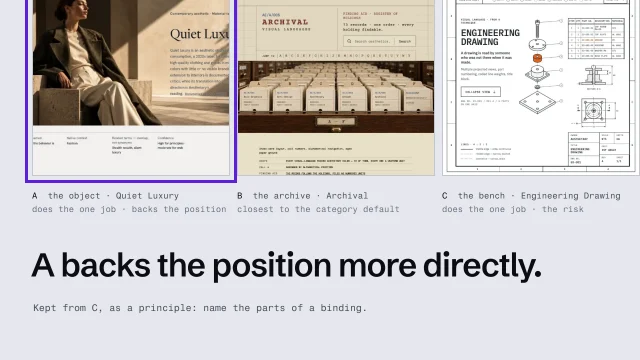 Develop three different directions, then chooseMake three directions that genuinely disagree, and choose between them on evidence.3 min video
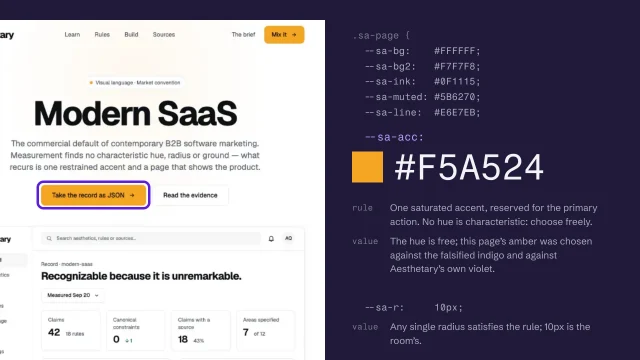 Turn the direction into a specification and tokensExpress a direction as a specification and named tokens a builder can check against.4 min video
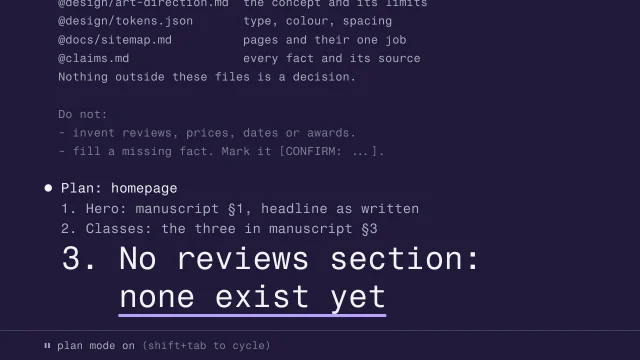 Brief an AI agent before it writes codeGive an agent everything it needs, and nothing it can misread, before it builds.4 min video
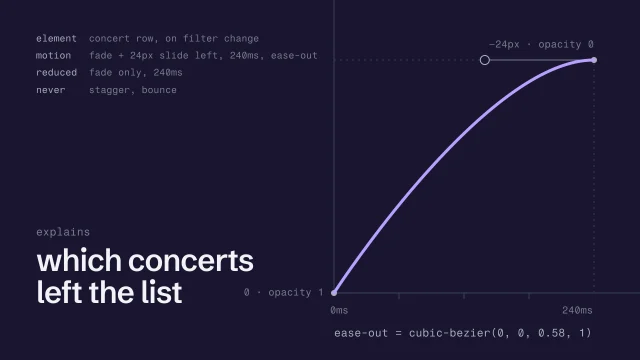 Use motion with restraintAdd only the motion that explains something, and keep the page working without it.3 min video
 Review the work against its briefJudge a build against what it was meant to do, not whether it looks good.4 min video