Build · Aesthetary Original
Brief an AI agent before it writes code
You'll be able to hand any AI builder a brief it can't misread: the documents to read, the never list, an approved plan.
In this skill
The agent will guess anything you leave out.
Name the documents, say what it must never do, and approve its plan before it builds.
2 more scenes are in the video and the transcript.
The mechanics, from the source
These come from the organizations that make the tools. They teach how the tool works; the skill above is about when and why to use it.
Official resource · Anthropic · Claude CodeOfficial documentation · Documentation
Best practices for Claude CodeDocs · 20+ min read
Giving Claude Code specific context, a way to verify its work, and a plan before code.
Transcript
An agent that starts coding from a one-line prompt fills every gap with the average website.
Here's what happens without a brief. You type: build the homepage for the bakery. The agent has never seen your brief, your manuscript or your tokens, so it guesses. You get a stock headline, three feature cards, a testimonial nobody gave and a blue button. Every one of those is a decision you didn't make.
A working brief has three parts, and you write all of them before any code exists. The context pack tells the agent what's already been decided. The do-not block names the mistakes you can predict. The spec is the agent's plan, written back to you, which you read and approve before it builds anything. The same three parts work in any AI builder, chat or coding tool.
The context pack is a list of documents, named exactly. Names, not summaries. If you paraphrase the brief into the prompt, the agent works from your paraphrase, and your paraphrase drops things. Give each document a few words on what it decides, so the agent knows the manuscript outranks its own copywriting. If your direction draws on a published style record, add that record's builder guide, which carries each rule with its evidence label. Then end on the line that matters most: nothing outside these files is a decision.
The do-not block comes from experience. Every line in it is a mistake you've watched an agent make, or one you can predict from this project. The bakery's founding year isn't known, so the agent will be tempted to make one up. Say no in writing. And say what to do when a fact is missing: mark it, don't fill it. Your project's standing instructions hold the rules for every session; the do-not block is for this build. Keep it short. The longer the list, the more of it gets skimmed past, by an agent as much as a person. Put the lines that would hurt the client first.
Now the spec. Ask the agent for a plan before any code, and tell it not to change any files yet. Many coding agents have a planning mode that does exactly this; if yours doesn't, say it in words. Ask it to write the plan against your context pack: which sections, which components, which tokens, which manuscript passage goes where. Then read it. This is the gate. If the plan says hero with tagline and your manuscript has no tagline, that's a guess, and you catch it here, where fixing it costs one sentence.
Here's the difference on the page. A plan you should send back uses words like compelling, key services and social proof. Those words name categories, and the agent will fill them with whatever's typical. A plan you can approve points back at your documents. Manuscript section one, headline as written. Today's bread, the four loaves the manuscript lists. And it says what's missing out loud: no founding year, because nobody has confirmed one. Send the vague steps back in writing. Approve the plan only when every step points at one of your documents.
When it's built, check the build against the same files you briefed it with. An agent stops when the work looks done to it, so give it a check it can run, and ask for evidence instead of a claim. Ask it to compare the page text with the manuscript and show you every difference. Ask for any color or size in the styles that isn't in the tokens. Then look yourself. The agent's report is evidence for you to read. The decision stays with you.
The agent builds from what's in the documents. Name them, say what it must never do, and approve a plan only when every step points at one of them.
Next 4
Everything in Build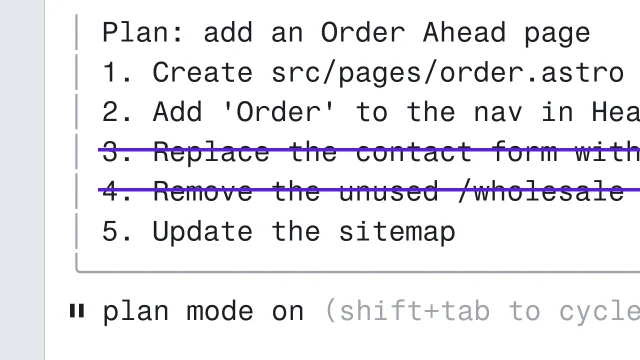 Steer a coding agent with plan mode and EscCheck which mode Claude Code or Codex is in, and strike any plan step you never asked for.3 min video
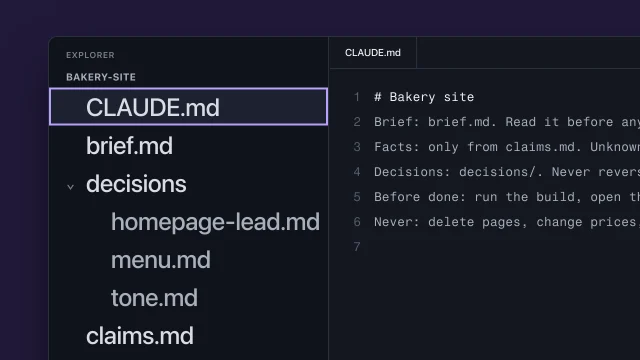 Keep your project in files the AI can readKeep a project in files so every AI session starts from what you already decided.4 min video
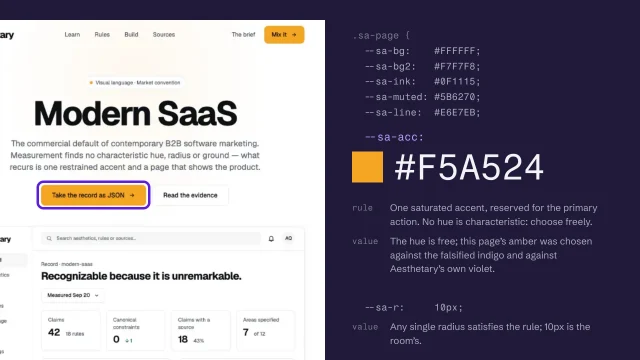 Turn the direction into a specification and tokensExpress a direction as a specification and named tokens a builder can check against.4 min video
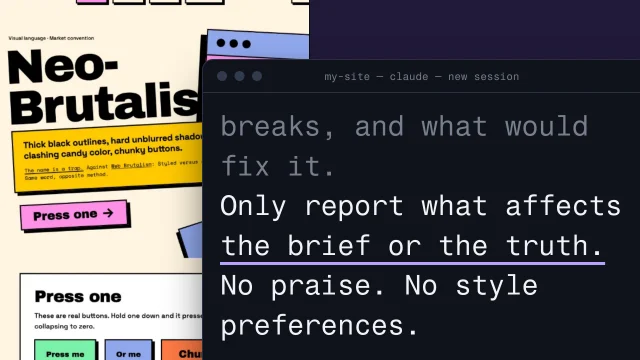 Get an honest AI reviewHave an AI review your work without it grading itself.4 min video