Test · Aesthetary Original
Review the work against its brief
You'll be able to judge a build against what it was meant to do, with every judgment pointing at a line someone already agreed.
In this skill
Judge the build against what it was meant to do.
- It looks good
- The hero feels a bit flat
- I love the colors
- Can we make it pop?
- Name the element
- Quote the line it breaks
- Say what changes
- Say why, in one sentence
Critique first, praise after
- Re-read the three documents
- List each failure, with its line
- Rank by harm to the one job
- Then name what works, and why
Every judgment cites the brief, the positioning or the recipe. If it can't, it's taste.
1 more scene is in the video and the transcript.
Transcript
Someone sends you a build and asks what you think. The weakest answer you can give is that it looks good. Plenty of sites look good, and saying so tells nobody what to change.
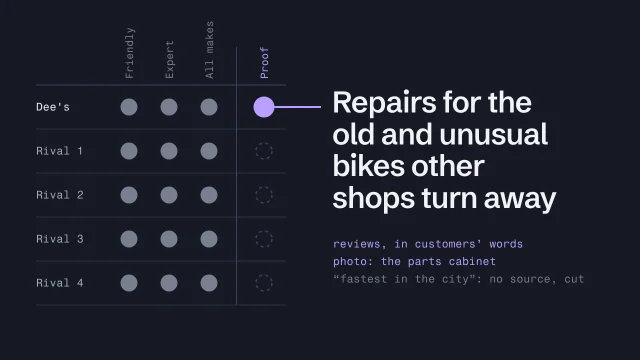
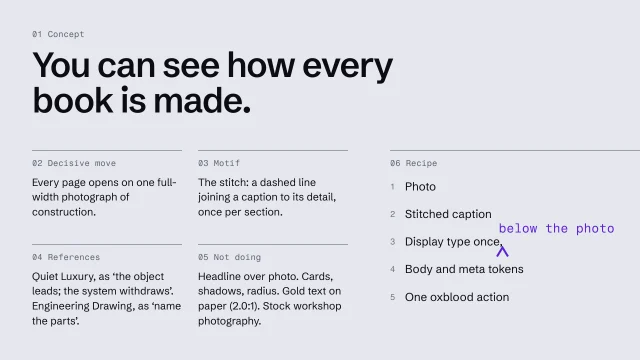
A review answers one question: does this build do the job it was given? You already wrote the job down. The brief says what the site must achieve, states its one job in a line, and ends with the checks it has to pass before sign-off. The positioning says what only this business can claim. The art-direction brief, with its recipe, says how it should look and why. Those documents are the standard. Your taste isn't.
Comments like these are feelings about the whole page. None of them can be acted on, and none of them can be argued with, which is the problem. A judgment names one element, quotes the line in the brief, positioning or recipe that it breaks, and says what should change. If you can't find a line to quote, you have two honest options. Find the gap in the brief and fix the brief, or drop the comment.
Do it in this order. Re-read the brief, the positioning and the recipe before you open the build, so you're holding the standard and not a first impression. Go through every page and write down each failure with the line it breaks. Rank them by how much each one gets in the way of the site's one job. Only then write what works. Critique goes first because praise anchors you. Once you've written that the hero is lovely, you start defending it. Don't skip the praise, though. What works, and why it works, is what nobody is allowed to break in the next round.
Here's the finding that matters most in the fictional bakery's review build, on October fourteenth. The brief's first sign-off check asks: is ordering ahead on the first screen? On a phone, it isn't. Here the phone's screen is three seventy-five by six sixty-seven pixels. The photo runs full width, the one Order ahead button starts at seven-thirty, below the screen, and the header folds the order link behind Menu. That breaks the site's one job, so it ranks first. The change keeps Order ahead visible in the phone header on every page, and leaves the photo-first rule from the art direction alone, because that rule is defended. On the sixteenth, the same check runs again on a phone, and it passes.
Then ask each page these questions. Start with the brief's sign-off checks, run exactly as written, on the device they name. Does the page serve the one job? Does it say something only this business could say? Is the decisive move from the art direction still there, and is the recipe followed on the inner pages, where builds usually drift? And can every claim on the page be traced to a source? A review that skips that last question can pass a site that's lying. The review is done when every sign-off check has been run.
Once the failures are listed, ask what would make this remarkable. A remarkable move has to trace back to evidence, like a confirmed claim or a customer's own words, or to intent declared in the brief. The bakery's customers keep writing “worth the queue”, and the positioning is already built on those words. What remarkable never justifies is a claim nobody confirmed, like the founding year the AI invented, lower contrast for the mood, or a skipped check because the client is waiting.
Last step, on every review: remove one thing. Builds collect elements because sites usually have them: a stats strip, a second call to action, a row of icons. Find the element that no line in any of the three documents defends, and cut it. If everything on the page is defended, say so and leave it alone.
If a judgment can't point to a line in the brief, the positioning or the recipe, it's taste. Find the line, or keep it to yourself.
Next 4
Everything in Test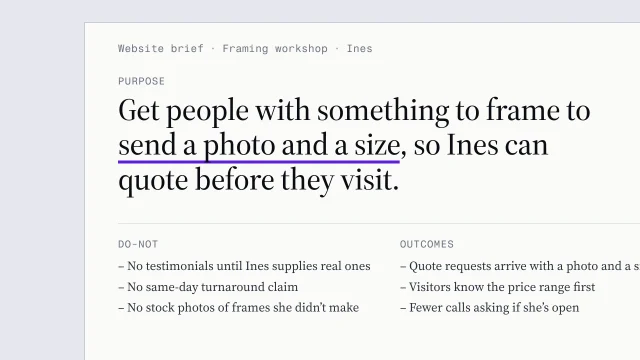 Write a one-page website briefWrite a brief that says what the site must do before anyone designs it.4 min video
 Position with proofChoose a position the business can back with evidence.3 min video
 Write an art-direction brief that survives the buildWrite a direction down so precisely the build can't drift from it.4 min video
 Get an honest AI reviewHave an AI review your work without it grading itself.4 min video