Test · Aesthetary Original
Get an honest AI review
You'll be able to have an AI review your build without it grading its own work, and decide for yourself what its findings mean.
In this skill
Get the review from something that didn't build it.
Set up the review
- Write your own critique first
- Save it, so the order is on record
- Open a fresh AI session
- Give it the standard and the build
- Sort its findings against yours
- The brief and positioning
- Art direction and recipe
- The review link or screenshots
- The claims list
- Your own critique
- The build conversation
- What you hope it says
- Who made it
Write your critique first, review in a fresh context, then sort every finding yourself.
2 more scenes are in the video and the transcript.
The mechanics, from the source
These come from the organizations that make the tools. They teach how the tool works; the skill above is about when and why to use it.
Official resource · Anthropic · Claude CodeOfficial documentation · Documentation
Best practices: the writer/reviewer patternDocs section · Section
Using a fresh context to review work, so the reviewer isn't biased toward code it wrote.
Transcript
Ask the session that built your page whether it's any good, and you'll usually hear that it is. It wrote the page. It remembers every reason it had for every choice.
So the review comes from somewhere else: a fresh AI session with no history of the build. The session that built the page remembers every reason it had, and it leans toward its own work. A fresh one sees only the page and the standard you give it. This lesson is about setting that up so the review is honest, and about what you do with what comes back.
The order matters more than the prompt. Write your own critique first, against the brief. Save it with the date, so it's on record that you decided before the AI did. Then open a fresh AI session with none of the build conversation in it. Give it the standard and the build. Then put its findings next to yours.
What you give it is the standard: the brief, the positioning, the art direction, the claims list, and the build itself. What you withhold matters as much. Keep your own critique back, because the point is two independent reads you can compare. If it sees your list, it has something to agree with. Keep the build conversation out, which is the reason for a fresh session in the first place. And leave out anything that tells it what you're hoping for, like I think this is nearly done, or I made this. Every hint makes the easy answer easier.
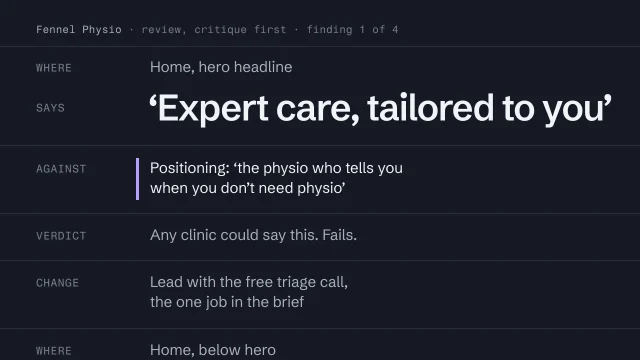
Here's the shape of the prompt I'd use. It names the files that count as the standard. It asks for each failure with its location, the line it breaks and a fix. And it limits findings to the brief and the truth. That limit is there because a reviewer asked to find problems will usually find some, even when the work is sound. If you don't narrow it, you get a list padded with preferences. On anything a client will see, I'd also run the same prompt past a model from another company, and check anything only one of them flags.
Now reconcile. The AI's list doesn't get obeyed. It gets sorted, and you're the one sorting. Some findings are correct, and they go on your fix list. Some point at a real problem but blame the wrong cause, so you fix the cause. Some aren't problems at all. Some are taste presented as a failure. And then there's the column that teaches you most: what it caught that you missed, and what you caught that it missed.
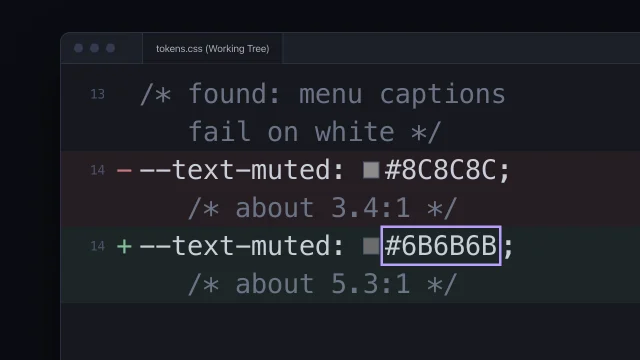
Here's what that looks like for the fictional bakery. The faint captions finding is right: the builder added a gray that wasn't on the design's list, so the fix is a color from the list. The testimonials suggestion is the AI filling a gap with something nobody has cleared, so it's a no until the owner says which reviews can be quoted. The empty space is taste, because no line in the brief asks for less of it. The menu finding has the right feeling and the wrong cause: the builder tidied the approved label, Today's bread, into Our range. And the hidden Order ahead button on phones is mine. The reviewer missed it. Write every miss in your AI log. Over a few projects, that log tells you where to trust it and where to look harder.
The reviewer finds things. You decide what they mean. Write yours first, review in a fresh context, and never let the builder grade its own work.
Next 4
Everything in Test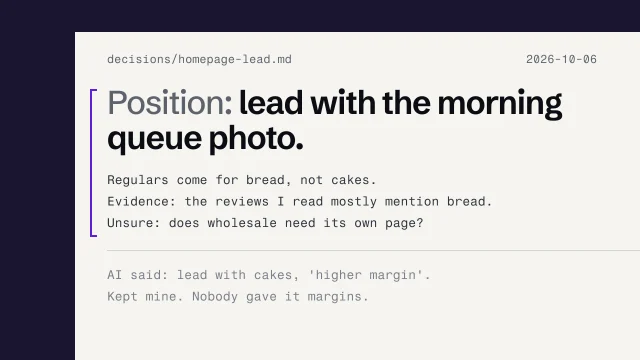 Decide first, then ask the AIPut your own answer in a file before any AI sees the question, then compare the two.3 min video
 Review the work against its briefJudge a build against what it was meant to do, not whether it looks good.4 min video
 Brief an AI agent before it writes codeGive an agent everything it needs, and nothing it can misread, before it builds.4 min video
 Fix accessibility at the sourceFix an accessibility failure where it starts, not with a patch on top.5 min video