Plan · Aesthetary Original
Position with proof
You'll be able to choose a position a business can back with evidence, and cut the parts it can't.
In this skill
A position is a claim this business can prove and rivals can't.
- Friendly, expert team
- Passionate about cycling
- All makes and models
- Fixes bikes others turn away
- Rebuilds hub gears in-house
- Keeps parts nobody else stocks
Find it before you test it
- Start from your evidence
- Draft one sentence: who, what, why
- Run the swap test
- Point every phrase at a source
Find the claim a rival couldn't make, and narrow it until every word has proof.
2 more scenes are in the video and the transcript.
Transcript
Every bike shop says it's friendly, expert and passionate about cycling. A visitor reads those words and learns nothing, because the shop down the road says them too. A position is what you can say that they can't. And you only get to say it if you can prove it.
Here's the working definition I use. A position says who the business is for and what it does differently, and every word of it points at evidence. Adjectives don't count. Anyone can type them.
Take a fictional repair shop. Dee runs it from a railway arch. Her current site says friendly, expert, all makes and models. Then look at the evidence you gathered. Her reviews keep coming back to the same thing: old three-speeds and steel frames, bikes another shop said weren't worth fixing. Her inventory has a photo of a cabinet of discontinued parts she's collected for years. There's the position. She fixes the bikes other shops turn away. None of that was on her old homepage.
Order matters. Start from what you've collected: the claims map, the customer language, the inventory. Don't start from what the owner thinks makes them special, because that's usually an adjective too. Draft one sentence: who it's for, what the business does, and why that's different. Read it out loud. It should sound like something Dee would say to a customer at the counter.
First, the swap test. Put a competitor's name on the sentence. If it's still true, it isn't a position. 'Friendly, expert repairs for all bikes' survives any name you give it, so it goes. 'Repairs for the old and unusual bikes other shops turn away' stops being true the moment you put a chain store's name on it. That one stays. If the sentence sounds like the category default, the line every competitor already uses, you've written the default again.
Second test: point every phrase at a source. 'Other shops turn away': the reviews say it, in customers' own words. 'Parts nobody stocks': the photo of the cabinet, plus Dee confirming it. Now say she also wants 'the fastest turnaround in the city'. Nobody has measured that. You don't soften it into 'fast'. You drop it. When the proof runs out, the position gets narrower. It never gets padded with a guess.
One more check. A position can be true, provable and unique, and still be useless, because nobody chooses a shop on it. Dee's is also the only shop on her street with a blue door. Provable, and nobody cares. The customer language tells you what people care about. Dee's reviews bring up the old bikes again and again. That's how you know this is the right position, and not merely a defensible one.
Then write it down where the brief can use it. Who it's for, what they're choosing between, what the business does, and the proof, each with its source. Add a line for what you're deliberately not claiming. That line stops the next person, or the next AI draft, from putting 'fastest in the city' back in.
An AI can spot the phrases your sentence shares with competitor copy, and find what customers keep saying in the reviews. Ask it what makes Dee different, though, and you'll get adjectives back. And it can never supply the proof. Proof comes from the business.
Find the claim a rival couldn't make, then narrow it until every word has proof behind it.
Next 5
Everything in Plan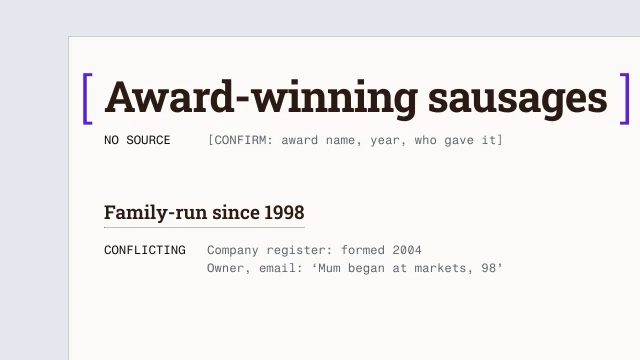 Map every claim to its sourceGive every claim on a site a truth status and a source before it's published.3 min video
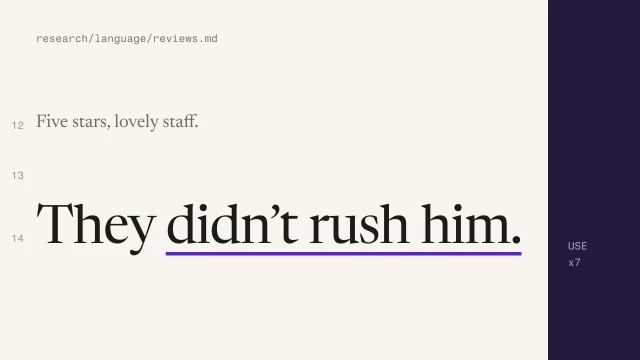 Mine customer language from reviewsFind the words customers actually use, and keep them.3 min video
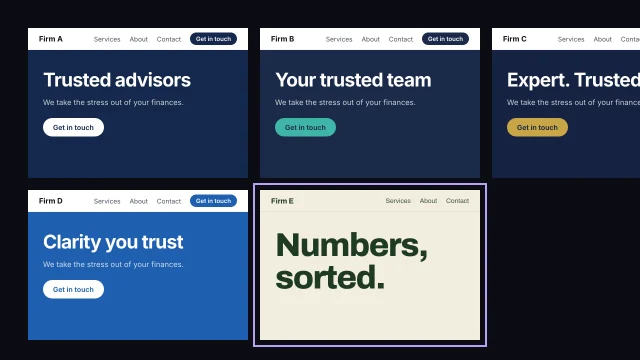 Find your category's defaultSee what every competitor looks and sounds like, so you don't repeat it.3 min video
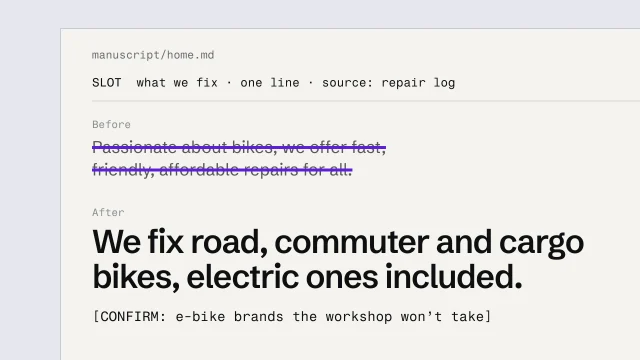 Write specific, true copy for each slotWrite copy only this business could say, and cut what sounds machine-written.4 min video
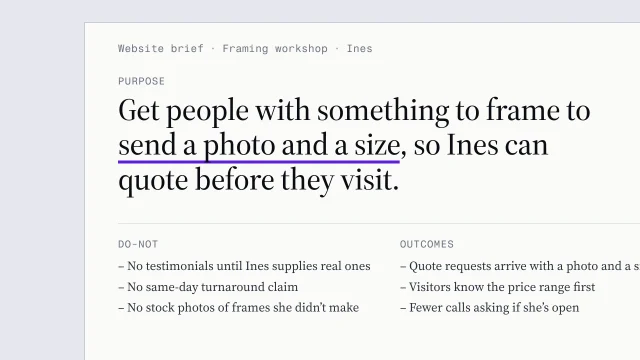 Write a one-page website briefWrite a brief that says what the site must do before anyone designs it.4 min video