Research · Aesthetary Original
Get the client's photos, numbered and intact
You’ll be able to collect a client’s photos at full size, strip their location, note who’s in them, and number them for good.
In this skill
Ask for the originals, not chat copies.
Follow one number through
- Contact sheet: P07
- Photo record: P07
- Asset plan: source P07
- Page file: p07-queue-1600.jpg
- Search the project for P07
Originals in, location out, people noted, and one number per photo, for good.
Transcript
The owner has about forty photos on her phone, mostly bread and the morning queue. Before any of them goes near a design, get them at full size, write down who and what each one shows, and give each photo a number that never changes.
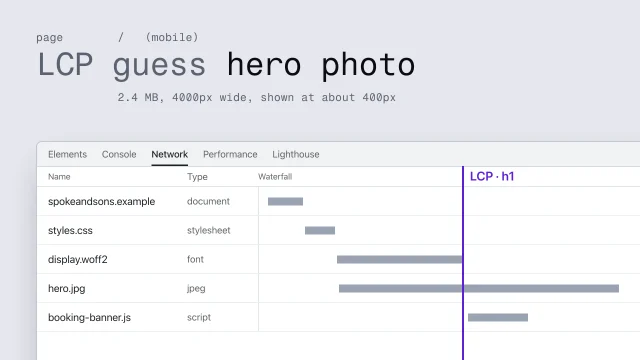
The first eight came through a chat. Each one is sixteen hundred pixels wide, and under a hundred kilobytes. Chat apps often send a smaller copy, unless the photo goes as a file. Here’s the same photo from the phone itself: four thousand and thirty-two pixels wide, two point three megabytes. A photo across the top of a page needs that one. So ask for the originals, all in one shared folder, or sent as files. Keep that folder exactly as it arrives, and back it up.
The original carries more than the picture: which phone took it, when, and exactly where. All forty have a location. Most were taken at the shop, but a photo taken at home carries the owner’s address. So keep the originals as they are, and work from copies with the location taken out. Three came from the head baker’s phone as HEIC files, which plenty of tools, and some AI agents, can’t open, so their copies are JPEGs. Then check the copies: none has a location left.
Now number the copies, in the order they were taken, P one to P forty. The numbers go in a small file, and onto a contact sheet: one page, every photo small, its number underneath. Now the owner can point at a photo by its number: use P seven. So can you, and so can an agent, and nobody has to describe one photo of bread among forty photos of bread. A number is never reused. The blurred one, P twelve, is dropped, and keeps its number. When the next photo arrives, it becomes P forty-one, and every number before it stays put.
Then give each number an entry in the photo record. Who took it and who allowed it come from the rights lesson. Add two questions: who is in it, and what does it show of a home? P seven shows two customers’ faces, so it waits for an answer. P seventeen is a customer’s child: that’s a no, however good the photo. P twenty-three is the owner’s own kitchen, so she decides. A blank is never a yes.
The number goes wherever the photo goes. In the record, P seven now says yes, cropped without faces, agreed on the twelfth. In the asset plan, the home page’s first image is P seven. On the page, the file is named after it. So when the owner changes her mind about a photo, search the project for its number. Every place it’s used comes back: the numbers file, the contact sheet, the record, the plan and the page.
Ask for the originals, take the location out, write down who and what each photo shows, and give it a number that never changes.
Next 4
Everything in Research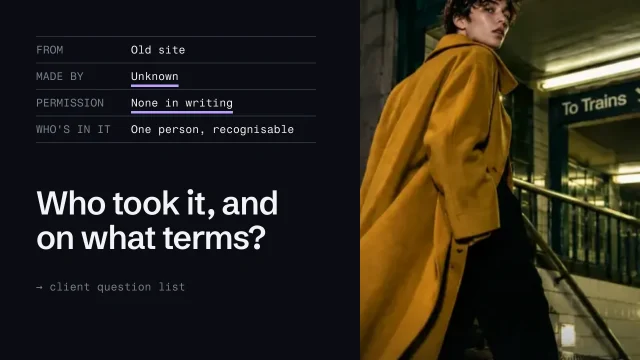 Check image rights and use AI imagery honestlyKnow which images you may use, and use generated images without misleading anyone.4 min video
 Build a source inventory you can trustTurn a harvest into an inventory where every item has a source and a date.3 min video
 Direct imagery: subject, crop and gradeChoose and treat images so they say what the page says.4 min video
 Predict, measure and fix performanceFind what makes a page slow and fix it at its origin.4 min video