Prepare · Aesthetary Original
Keep your project in files the AI can read
You'll be able to set up a project so every AI session starts from what you've already decided, not from zero.
In this skill
Every session starts empty. Your files are the memory.
If it isn't in a file, the next session doesn't know it.
2 more scenes are in the video and the transcript.
The mechanics, from the source
These come from the organizations that make the tools. They teach how the tool works; the skill above is about when and why to use it.
Official resource · Anthropic · Claude CodeOfficial documentation · Documentation
How Claude remembers your project (CLAUDE.md)Docs · 25 min read
Where CLAUDE.md files go, what to put in them, and how Claude reads them.
Official resource · OpenAI · CodexOfficial documentation · Documentation
Custom instructions with AGENTS.mdDocs · 5 min read
Project instructions for Codex in AGENTS.md, and which file wins when several apply.
Transcript
You spent an hour agreeing the tone of voice with the AI. Tomorrow you open a new session and it's forgotten every word.
That's how these tools work. Anthropic's docs put it directly: each Claude Code session begins with a fresh context window. Codex rebuilds its instructions from your AGENTS.md files every time it starts. What carries over is what's in your project's files. So the habit is easy to say. Anything you'd be annoyed to explain twice goes in a file, in the project folder, under Git. The brief. The decisions. The facts still waiting on the client. Chat is where you work things out. The file is where the answer lives.
Here's a fictional bakery project. The brief says what the site is for. The decisions folder holds one short dated file per decision, so you can see when and why. Claims lists every fact on the site with its source. The AI log is the one from the first lesson in this stage. The build sits in its own folder. None of this needs to be clever. It needs to exist, with names you'd guess.
CLAUDE.md is the file Claude Code reads at the start of every session. Codex reads one called AGENTS.md, and Claude Code can read that too. Keep it short. Anthropic suggests under two hundred lines, because long files get followed less. Put in where things are kept, the rules it keeps breaking, and the checks to run before it says it's finished. Point to the brief instead of pasting it in. And use their test on every line: would taking this out cause a mistake? If not, cut it.
A few lines from that file. Notice how little it explains. It says where the brief is and when to read it. It says where facts come from and what to do when one's missing. It tells the agent not to quietly reverse a decision that has a file. And it lists what it must never do on its own, like changing prices. Every line is there because something went wrong, or would have.
When you ask for work, point at files by path. Use the tone we agreed means nothing to a session that wasn't there. Follow decisions slash tone dot md does. In Claude Code you can type an at sign and the file name, and it reads the file before it answers. Pasting the brief into chat works once. Pointing to the file works every time, and when the brief changes there's only one copy to update.
So end every session the same way. Ask for the decision in a file. Something like: write what we agreed about the menu page into decisions slash menu dot md, with today's date and the reason. Read what it wrote, because it will sometimes record a tidier version of the conversation than the one you had. Correct it. Commit it. Then the next session, or you in three weeks, starts from the decision rather than the chat that produced it.
Files have one more property chats don't. They build on each other. The homepage copy was written from the brief. The order page was built from the copy. So when the client changes the brief, those files are suspect, even though nothing in them has changed. Write it down. A line at the top of each file that depends on it, or a decisions entry: brief changed on this date, copy needs checking. Then check it, or note why it still holds. Don't expect the agent to notice. It works from what's in front of it.
If it isn't in a file, the next session doesn't know it.
Next 3
Everything in Prepare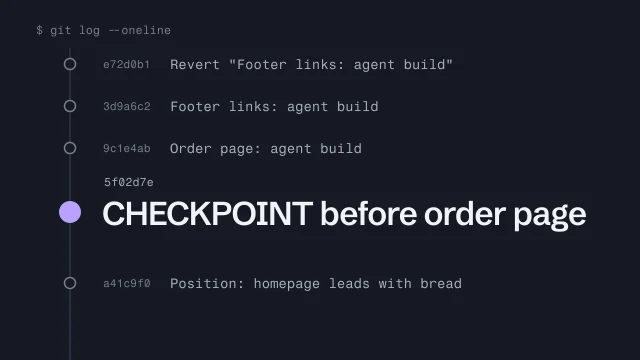 Use Git as a checkpoint before an AI agent changes your buildMake a save point before an agent touches your work, and get back to it.4 min video
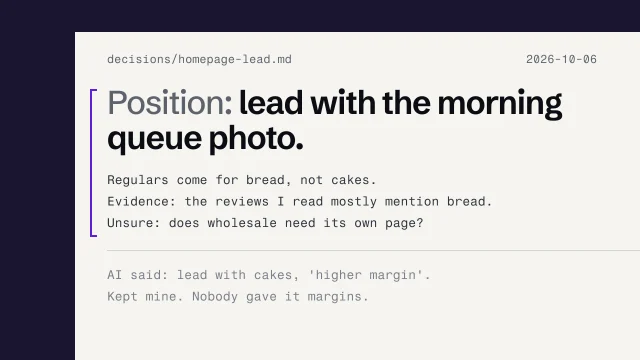 Decide first, then ask the AIPut your own answer in a file before any AI sees the question, then compare the two.3 min video
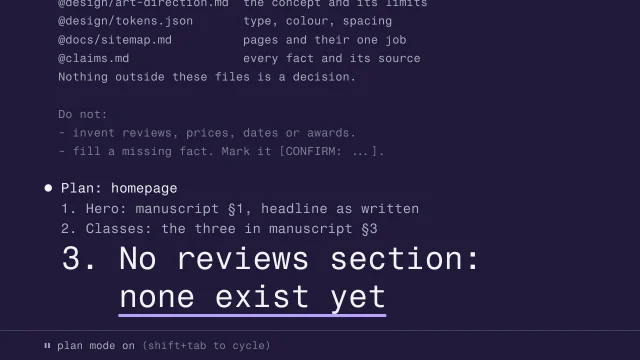 Brief an AI agent before it writes codeGive an agent everything it needs, and nothing it can misread, before it builds.4 min video