Design · Aesthetary Original
Read an Aesthetary record
Tell a documented rule from Aesthetary's reading, and a look's rule from a writing system's, before you build on either.
In this skill
Every rule says what kind of claim it is.
- What sort of statement this is
- Strength, from Necessary down
- 'our ranking' = tier is ours
- How it was established
- Not researched yet
- No grade recorded
Know what kind of claim you're building on, and whose rule it is.
2 more scenes are in the video and the transcript.
Transcript
You're about to paste a record into your agent and say 'build this'. Some of those rules come from a source. Some are the record's own reading. A few belong to a written language and have nothing to do with the look. The record tells you which, if you know where to look.
Every rule on a record carries a label for the kind of claim it is. That's the standard this course sets itself: you should be able to ask 'is this part of the aesthetic, or your recommendation?' and get the answer without reading a footnote.
These are the ones you'll meet most. Documented means a source states it, and the source is attached. Seen in the work means someone inspected real artifacts and observed it. Our reading is the record's own conclusion from the material; no single source says it. Web translation is how the record applies the language on screen, which the aesthetic itself never specified. And Not part of the aesthetic marks an accessibility floor or current practice that would apply to any build. That last one matters more than it looks. A contrast rule printed on the Swiss record isn't Swiss, so nobody gets to cite it as the style, or drop it because the style didn't ask for it.
Here's Swiss Style's agent guide. Flush left, ragged right is ranked necessary, and it's seen in the work. The column count for screens is the record's own reading: the period work was print, so somebody had to decide. The contrast line is a floor for any site. Three rules in one guide, and you treat each differently. Break the first and it isn't Swiss. Change the second with a reason. Never drop the third.
There's a second label, and it's separate. Evidence says how the claim was established, and the kind never stands in for it. Strength is a third thing, from necessary down to unreliable, and 'our ranking' means the record set the tier, not a source. Two evidence labels catch people out. Not researched yet means nobody has looked, so it's neither permission nor a blank to fill. No grade recorded means the record simply doesn't say.
On a record, what the record decided itself is set in red with a dotted underline, and labeled Ours. On the Swiss Style record, 'Zero. No rounding on any element.' is marked that way, because that's the record's decision, not the source's. Ours on a record page and Our reading in a guide are the same kind. Square brackets mean something else here: a gap in a draft that has to be filled before anyone sees the page. Borrow the habit for your own briefs, so a client can see what came from them and what came from you.
A rule like 'set it vertically, read right to left' belongs to Japanese writing. Manga uses it because manga is Japanese. Carry it into an English-language site and what you've built is a mangled writing system. So rules on a record can be scoped to a script, and where a rule has no script recorded, the record says exactly that.
Swiss Style has a live case. One of its elements declares a left-to-right reading order. Reading direction belongs to a writing system, and nothing records which one this describes, so the record won't hand it to your agent as an instruction. It sits under open questions instead. No writing system recorded doesn't mean Latin. It means nobody has established which script the rule describes. That guards against a quiet failure: a mostly Latin corpus starts treating Latin as the default, and every other script as a deviation. If you build for Arabic or Japanese readers, check a rule's script before you trust it.
So before any rule goes into your brief, read its kind. Then its evidence. Then check whether it's scoped to a script. A necessary rule you keep. A reading of ours you may adapt, with a reason. An open question you hold until somebody answers it.
Know what kind of claim you're building on, and whose rule it is.
Next 4
Everything in Design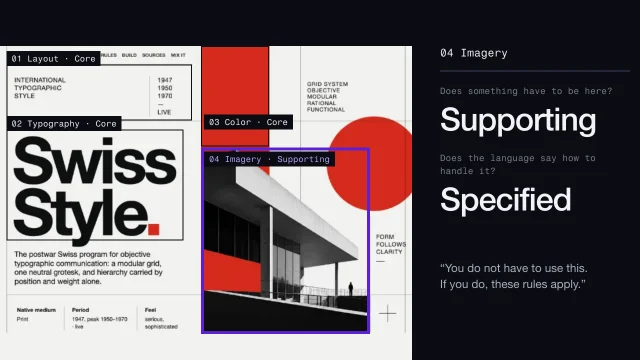 Read a visual language area by areaDescribe any look in the same twelve areas, so nothing is skipped or assumed.4 min video
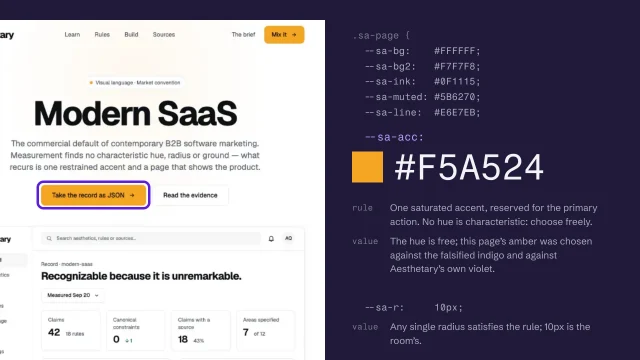 Turn the direction into a specification and tokensExpress a direction as a specification and named tokens a builder can check against.4 min video
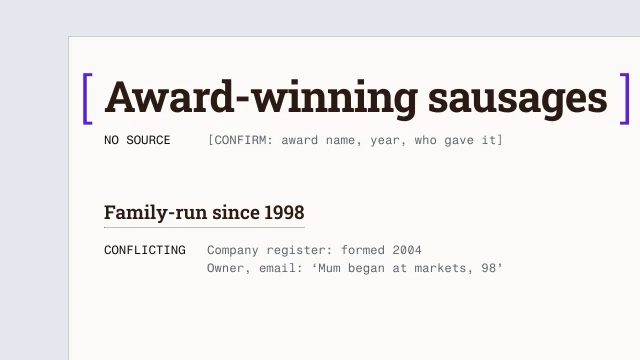 Map every claim to its sourceGive every claim on a site a truth status and a source before it's published.3 min video
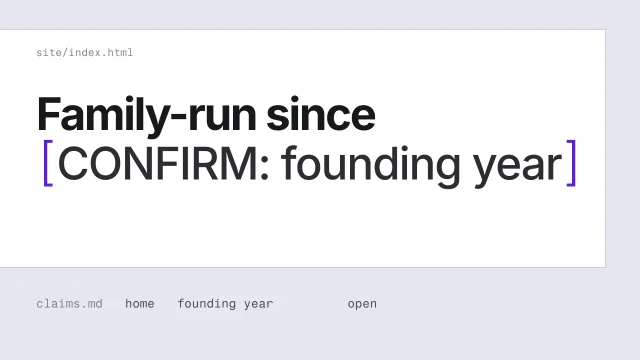 Never invent a factHandle a fact you can't confirm without putting a believable guess on the page.3 min video