Design · Aesthetary Original
Read a visual language area by area
Describe any look in the same twelve areas, and say plainly where a language is silent.
In this skill
Silence never becomes permission.
- Swiss Layout: core
- Swiss Imagery: supporting
- Swiss Motif: ruled out
- Whole modules, on the grid
- Objective photos, by function
- Adding it makes another look
Ask every area two questions, and never read silence as permission.
4 more scenes are in the video and the transcript.
Transcript
Ask someone to describe Swiss Style and you'll hear grid, Helvetica, red. Of those three, the Swiss Style record requires only the grid, and the description skipped nine areas entirely. Here's how to read a look so nothing gets skipped or assumed.
Every record describes its look in the same twelve areas. Layout is how the surface is divided. Typography is letterforms and how text is set. Color asks how many colors do work, and what each one is for. Imagery is what pictures are allowed to do. Surface is what the page is made of. Interface is radius, borders and elevation. Then motion, motif, the production technique the look depends on, and form, which is three-dimensional organization where a language has one. Hierarchy and density work differently. They hold rules, but they have no overall position of their own. Context sits apart and is never scored: 'also called International Typographic Style' is true, and tells you nothing about where a heading goes. Because the set is fixed, you can write your own direction in the same twelve and lay it next to any record.
Ten areas carry an overall position, and each one gets two questions, answered separately. Does something have to be here? And if it is, does the language say how to handle it? Swiss Style shows why they come apart. Imagery is supporting, so you don't need pictures at all. Use them, though, and the record is strict: photographs treated as objective records, placed by function. Optional presence, constrained treatment. Merge the two questions and you lose that.
Open the Swiss Style record from Explore and scroll to Build. The record lists its areas, each with a state, and the states are precise. Core means the language isn't itself without this. Ruled out means adding it builds something else. Not specified by the source means the area doesn't apply. Interface and motion both postdate the language, so there's no position to record, which is a different thing from a position against them.
This is the distinction that does the most work. 'The language lets you choose' and 'nobody has looked into it' read the same in a careless write-up. They're opposite instructions. Swiss Style's technique area is the first kind: historically offset litho, but nothing in the language requires a process, so you choose. Japanese Minimalism's record says outright that its positions by area aren't researched yet. Same blank look. Completely different license.
The record's rule for this is four words. Silence never becomes permission. When an area is unresearched, you don't fill it with whatever sounds right for the name. You decide it from your brief and your client's evidence, and you write down that that's what you did.
Then turn the frame on your own work. Write all twelve headings before you write anything else, so no area gets skipped for being boring. For the ten with a position, answer the presence question in a word: core, supporting, ruled out. Then write the handling. And wherever you haven't decided, or have no evidence, write exactly that.
Here's a first pass for a fictional bookbinder, all twelve areas. Look at motion, motif and technique. Motif is ruled out, a decision. Motion says not decided, and technique says not researched. Those two honest lines will save you an argument with your agent later. 'Motion: not decided' is useful. A blank invites the AI to fill it with its default, and then claim the brief allowed it.
Every area gets two questions. And silence stays silence.
Next 3
Everything in Design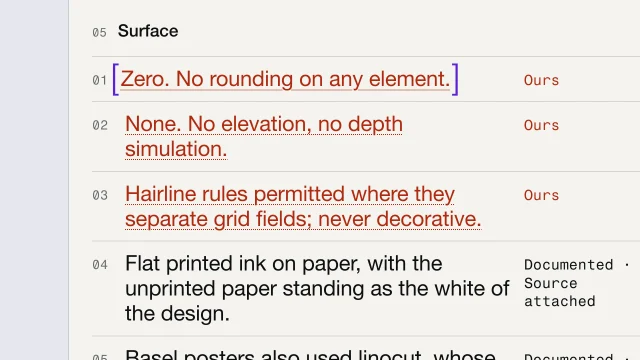 Read an Aesthetary recordTell a documented rule from Aesthetary's reading, and a look's rule from a writing system's.4 min video
 Spot AI-design tellsSee what makes a page look generated, and fix it.3 min video
 Develop three different directions, then chooseMake three directions that genuinely disagree, and choose between them on evidence.3 min video