Research · Aesthetary Original
A SWOT from your research, every line sourced
You'll turn your research into a SWOT where every line cites its source and ends in what the site will do.
In this skill
Each line ends in a decision
A SWOT on every project: every line sourced, every line a decision.
Transcript
Research gives you facts. A SWOT turns them into a few calls the site has to act on: what to lead with, what to fix, what to use, and what to watch. Do one on every project, and make every line point at where it came from.
Start with the other events, at the level of the business. This research is from October, and it says so: it isn't presented as how their sites look today. Web Summit makes the ticket path obvious and uses its scale for urgency. The next one sells the experience of being there. OFFF lets art direction carry the event. SXSW shows its long history. Then the line that matters: where AllWeb can win. A focused one-day event for the region, not a smaller Web Summit. Strengths and weaknesses are about AllWeb itself. Its history is real, in AllWeb's own published numbers. Its talks are on video back to 2017. The weakness: that proof is spread across the site, social channels and video. And on the fifth of October, no talk titles were out yet. Opportunities and threats come from outside. Gather the talks and photos into one archive, and answer when and where first, for search and for AI answers. The threat: bigger events with clear ticket paths compete for the same attention. That one is an inference from the research, and the line says so.
Every line ends with what the site will do about it. Those lines are where Plan starts.
Do a SWOT on every project. Build it from your research, cite a file or a dated source on every line, and end each line with what the site will do.
Next 3
Everything in Research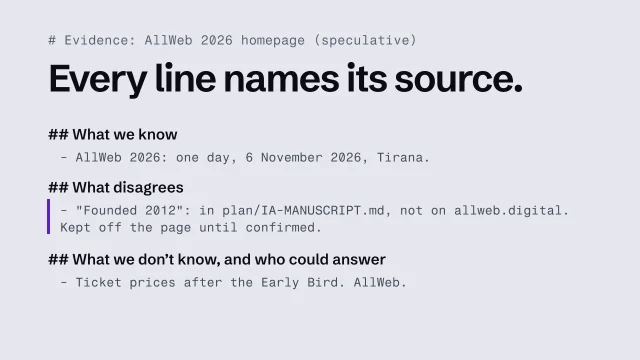 Put the research on one evidence pageTurn the research folder into one page Plan can start from: known, disputed and unknown, each line with its source.2 min video
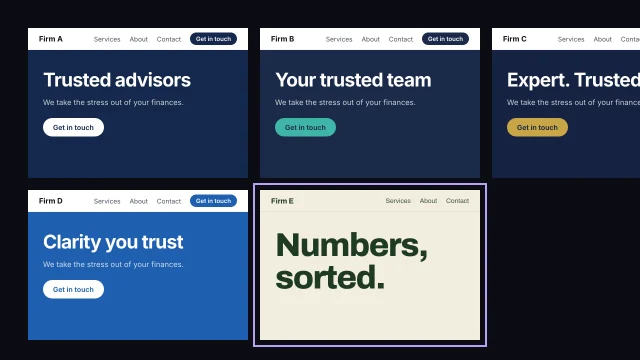 Find your category's defaultSee what every competitor looks and sounds like, so you don't repeat it.3 min video
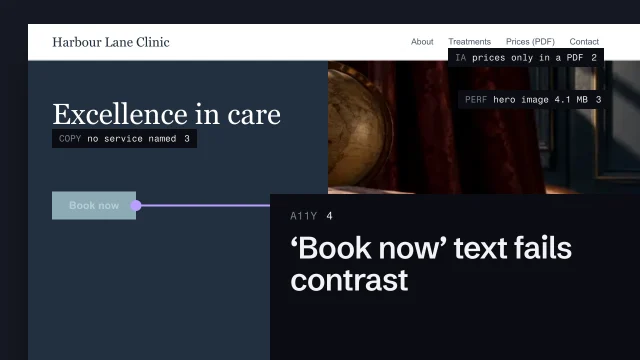 Audit an existing siteLook at a current site several ways and decide what matters most.4 min video