Prepare · Aesthetary Original
Your tools and accounts, and who owns each
You'll write one file that says what each tool is for, whose account it is, and who can get in.
In this skill
Check every line against the project
Name the jobs, put accounts in the client's name, never a password.
Transcript
Before you build anything, write down your tools and accounts: what each one is for, whose account it is, and who can get in. It takes ten minutes now. It saves a hunt for logins at the end.
Start with the jobs, not the products. Something to think with and argue with. Something that edits the files. A history of every change. A host that serves the site, a way to count visitors, a way to send form email, and a domain. Products change every few months. The jobs don't. Then write what does each job on this project, one line each: the job, the tool, whose account it is. On my AllWeb redesign, an AI chat did the thinking and the critique. A coding agent edited the files, and the host serves a preview.
Check each line against the project, not your memory. The host's project name comes from the project's own link file. The visit counter is loaded by the site's script. And the site sends no form email at all: eighteen lines in the page are marked demo only. So two jobs have no tool, and the file says so: no form email, and no domain. A blank you wrote down is a decision. A blank you forgot turns up at launch.
This site is speculative, so every account is mine. When a client commissions a site, the host, the domain, the analytics and the form email are opened in the client's name, and you're invited in. If they sit on your account, the client's site depends on yours. Write down who holds each login, and the handover at the end is a list, not a hunt.
One rule for this file: no passwords and no keys. Keys live in a local file that never goes into history, and the project's ignore list already keeps it out. The lesson on secrets shows the rest.
Name the jobs, then the tools. Put every production account in the client's name, write down who holds each login, and never put a password in the file.
Next 3
Everything in Prepare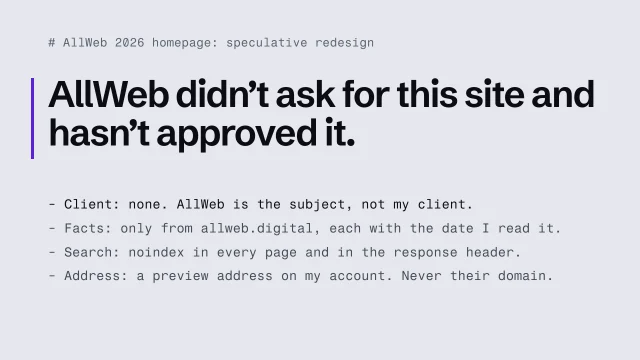 Speculative or commissioned: decide which you're doingKnow whether anyone asked for the site, and write down what that changes: credit, facts, search and the address.2 min video
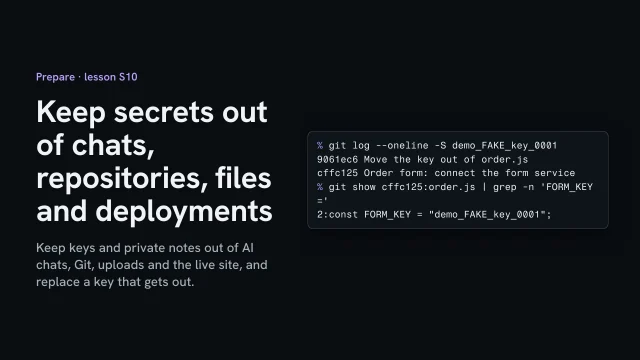 Keep secrets out of chats, repositories, files and deploymentsKeep keys and private notes out of AI chats, Git, uploads and the live site, and replace a key that gets out.3 min video
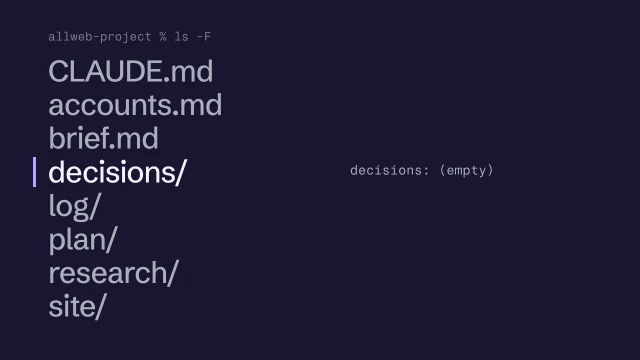 Organize the project folderGive the brief, research, plan, decisions, AI log and site one place each, with the real files in and secrets out.2 min video