Composition / Element
Elements
75 devices in 8 areas. Each one is a plate.
Plate 12 · Composition
Modular grid
A column grid crossed by horizontal flowlines, producing a matrix of modules that content is composed from in whole units.A live demonstration by Aesthetary, built from the recorded description. A specimen, not evidence.Where hierarchy comes from
The same four items made important by size and a filled block, placed freely. It can look fine. It isn’t a modular grid: nothing aligns to a module.
“An element is important because of where it sits and how many modules it claims, not because it has been enlarged or coloured.”
Composition·
What stays put, what can change
Stays put from the record
- Element alignment: whole modules
- Hierarchy device: position and interval
Free to change what the record leaves open
- The module count: “a decision, not a default”
- Column count (the record’s example uses 6)
- Typeface and color, as long as neither carries the rank
Where it appears
-
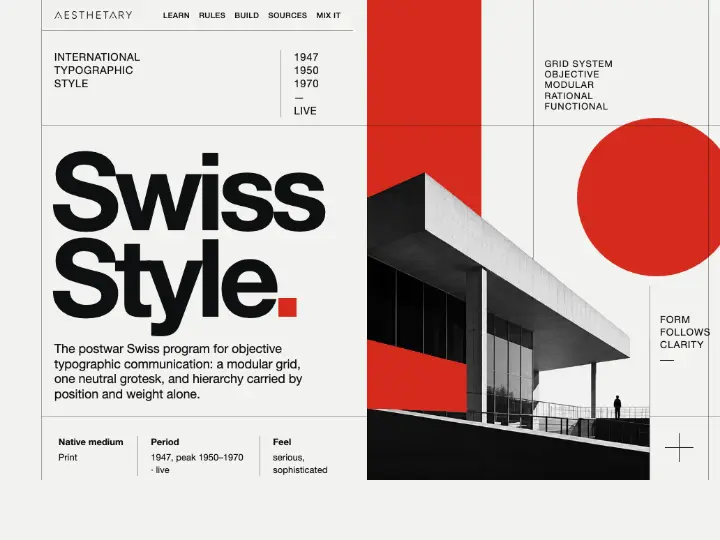 Swiss Style
Hierarchy comes from systematic placement in the grid. Where size signals importance, it is drawn from a few formats that are whole multiples of the grid field.
typography · historical practiceSet all text to a shared baseline rhythm derived from the grid module.
typography · historical practiceBuild a module matrix: columns crossed by horizontal flowlines. Every element occupies whole modules.
grid · canonical constraintColumn count in the range 4 to 12 for a screen layout; gutter equal to one module unit.
grid · Aesthetary’s operationalizationHairline rules permitted where they separate grid fields; never decorative.
rule_treatment · Aesthetary’s operationalization
The pictures show each whole Aesthetic, not this Element on its own. The rules are that Aesthetic’s, quoted from its record.
Read the full definition
Adopting this means the page is divided into columns and those columns are crossed by horizontal flowlines, so the surface becomes a matrix of modules separated by gutters. Every element — text block, image, caption — occupies a whole number of modules and aligns to module boundaries, and groups of modules form spatial zones reserved for a purpose. The consequence is that position and interval carry hierarchy: an element is important because of where it sits and how many modules it claims, not because it has been enlarged or colored. The module count is a decision, not a default; a finer matrix permits more arrangements and enforces less.
Evidence and provenance
- Record
modular-grid· Composition- Definition
- Full record: summary, definition, properties and constraints.
- Specimen
- Drawn by Aesthetary from the recorded description. Specimens may demonstrate a claim and never evidence one.
- Cultural review
- No cultural flag on this Element or its source.
Tools for this area 3
Aesthetary teaches the idea. These are other people’s tools under their own licenses. Linking to one is not permission to redistribute it, and Aesthetary bundles none of them.
- Every LayoutLink onlyProprietary. Checked 2026-10-06.
- MDN CSS grid layout guideRecommendProse CC BY-SA 2.5 or later. Checked 2026-10-06.
- web.dev Learn CSS: LayoutRecommendContent CC BY 4.0. Checked 2026-10-06.